Why PTFE Joint Sealant is Ideal for Irregular and Damaged Flanges
Home » Why PTFE Joint Sealant is Ideal for Irregular and Damaged Flanges
17 Feb, 2026
Why PTFE Joint Sealant is Ideal for Irregular and Damaged Flanges
Flange damage can get expensive. Whether it’s pitting from corrosion, gouges from improper maintenance, or surface irregularities from years of service, damaged flanges create leak paths that traditional gaskets struggle to seal. The cost of machining or replacing flanges can run into thousands of dollars, plus downtime.
PTFE joint sealant offers a practical alternative: a form-in-place sealing solution that conforms to imperfect surfaces and creates reliable, leak-free seals without costly repairs.
Key Takeaways
Here’s what makes PTFE joint sealant the go-to solution for damaged flanges:
Conforms to irregular surfaces: The soft, marshmallow-like material fills scratches, pits, gouges and dents that would compromise traditional gaskets
Chemical resistance: Handles virtually all chemicals (pH 0-14) in food, pharmaceutical, chemical processing and industrial applications
Low bolt torque required: Ideal for fragile equipment like glass-lined vessels and plastic flanges where high compression isn’t possible
FDA compliant: Meets FDA 21 CFR 177.1550 for direct food contact in dairy, beverage and pharmaceutical operations
Fast installation: Cut to length on-site, no waiting for custom gasket fabrication
The Reality of Flange Surface Damage
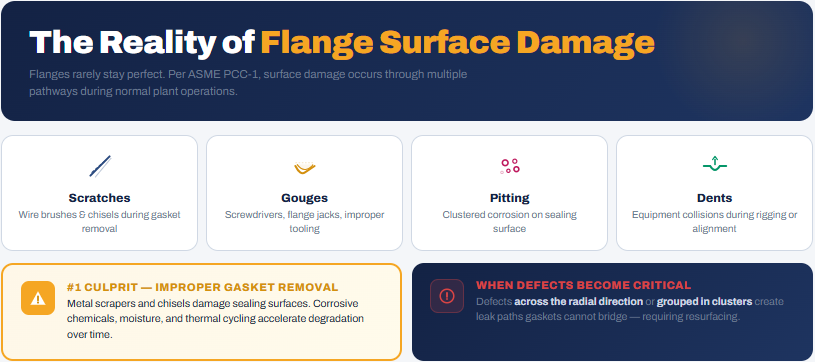
Flanges rarely stay perfect. According to ASME PCC-1 guidelines on bolted flange joint assembly, surface damage occurs through multiple pathways during normal plant operations.
Common types of flange damage include:
Scratches: Narrow, elongated marks created when sharp objects drag across the flange face, often from wire brushes or chisels during gasket removal
Gouges: Wider depressions with rounded bottoms, typically caused by screwdrivers, flange jacks or improper tooling
Pitting: Small, rounded areas of material loss from corrosion, usually appearing in clusters on the sealing surface
Dents: Impact damage from equipment collisions during rigging operations or flange alignment
The most common culprit? Improper gasket removal. Maintenance teams using metal scrapers or chisels to remove old gasket material inadvertently damage the sealing surface. Over time, exposure to corrosive chemicals, moisture, and thermal cycling accelerates degradation, particularly in harsh environments, such as chemical processing plants and offshore facilities.
If defects are large (especially across the radial direction) or grouped in small areas, the leak path can exceed a traditional gasket’s ability to block it. That’s when facilities face a choice: expensive flange refacing, complete replacement, or a more flexible sealing solution.
Why Traditional Gaskets Struggle with Damaged Surfaces
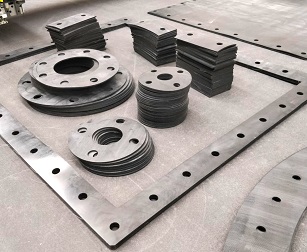
Traditional cut gaskets, whether spiral wound gaskets, CNAF gasket sheet or standard rubber, are manufactured to specific dimensions. They rely on uniform compression across the entire sealing surface to create a barrier. When a flange face has irregularities, these rigid gaskets can’t adapt.
A scratch or pit creates a microscopic gap. Under pressure, process fluids find these gaps and leak. The gasket might seal 99% of the surface area, but that remaining 1% becomes a leak path. In high-pressure uses or when handling hazardous chemicals, even small leaks pose safety and environmental risks.
Some facilities respond by over-tightening bolts, hoping increased compression will force the gasket into damaged areas. This approach typically backfires, as it damages the gasket through crushing or extrusion, potentially cracking fragile flanges, and exceeding bolt stress limits outlined in ASME standards. The joint might hold initially, but fails prematurely under thermal cycling or pressure variations.
How PTFE Joint Sealant Solves the Problem
Expanded PTFE sheet technology transformed flange sealing in challenging applications. Unlike virgin PTFE sheet, which is relatively rigid, expanded PTFE undergoes a specialised manufacturing process that creates a soft, highly fibrillated structure.
The expansion process creates millions of microscopic fibres, giving the material its unique characteristics. When compressed, these fibres pack tightly together, filling surface irregularities and forming a thin, dense ribbon that blocks leak paths.
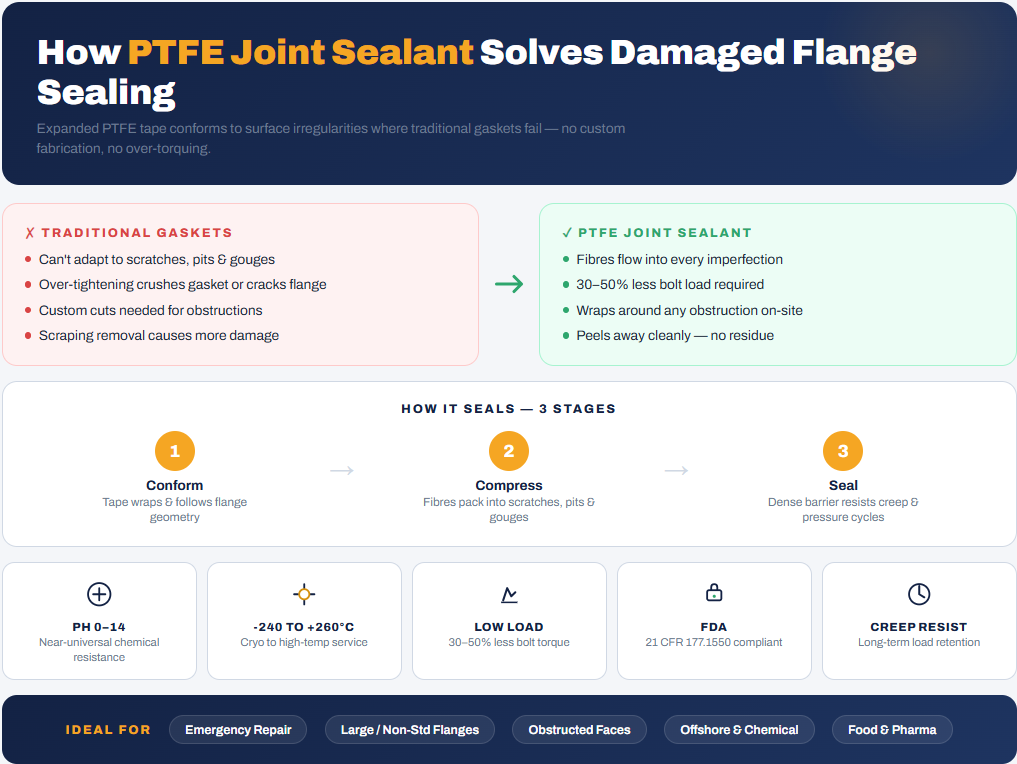
The sealing mechanism works in three stages:
First, the tape conforms to the flange geometry as you wrap it around the sealing surface. Its flexibility allows it to follow complex shapes, work around obstructions like sight glasses or fixed studs, and adapt to non-standard flange configurations.
Second, as you tighten bolts, the material compresses, leaving scratches, pits, and gouges. The soft, spongy structure flows into imperfections under relatively light bolt load – typically 30-50% less than required for traditional gaskets.
Third, the compressed material forms a dense, impervious barrier. Despite significant compression, the fibrillated structure maintains mechanical strength and resists creep (cold flow) that plagues standard PTFE. The result is a reliable seal that maintains integrity through pressure fluctuations and thermal cycling.
Key Performance Benefits
PTFE joint sealant delivers characteristics that make it particularly valuable for damaged or irregular flanges across multiple industries.
Exceptional chemical compatibility: The material resists virtually all industrial chemicals, solvents and petroleum products from pH 0-14. The only exceptions are molten alkali metals and elemental fluorine at extreme temperatures and pressures. This makes it suitable for aggressive chemical environments where different gasket materials might degrade rapidly.
Temperature extremes: Continuous service from -240°C up to +260°C, with short-term capability to +310°C. Whether you’re sealing cryogenic systems or using high-temp gasket materials, it maintains sealing integrity without hardening or becoming brittle.
Low compression requirements: This is critical for damaged flanges. Because the material is so compressible, it creates effective seals even when bolt load is limited by flange condition, material constraints, or equipment fragility. Glass-lined vessels, ceramic flanges and certain plastic materials simply can’t withstand high bolt torque.
FDA compliance: Pure expanded PTFE meets FDA 21 CFR 177.1550 for direct food contact. It has no smell, taste or leachable contaminants, making it ideal for dairy, beverage, pharmaceutical and food processing applications where product purity is paramount.
Creep resistance: Standard PTFE suffers from cold flow under constant load, gradually thinning and losing sealing effectiveness. The expanded structure significantly reduces this tendency, maintaining seal integrity over extended service life.
Real-World Applications
PTFE joint sealant proves particularly valuable in specific industrial scenarios where traditional gaskets create challenges.
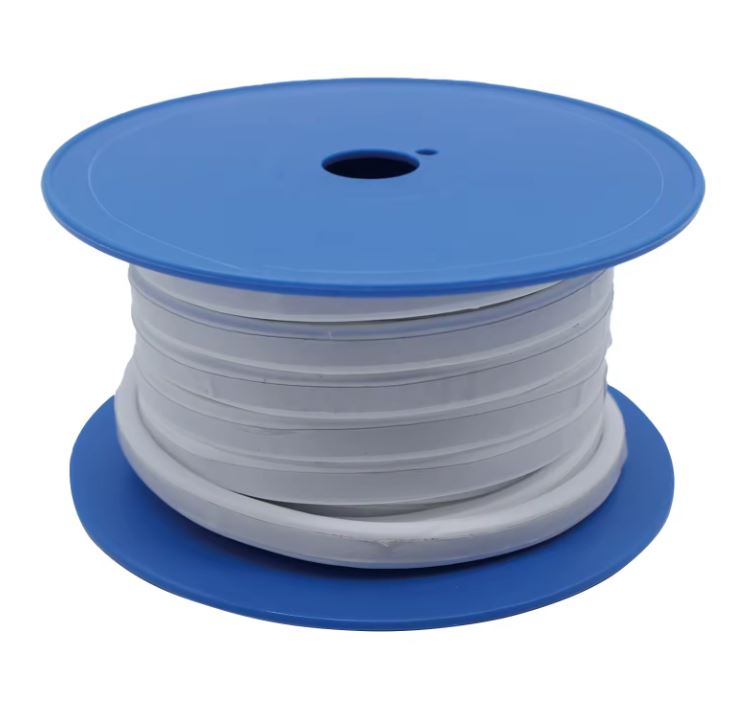
Maintenance and repair operations: When a flange is damaged during an unplanned shutdown, waiting days for a custom gasket isn’t an option. PTFE joint sealant ships on spools. Simply cut the length you need, wrap the flange, and you’re operational within hours. No special tooling required, no fabrication delays.
Large or non-standard flanges: Manufacturing a one-piece gasket for a 1.5-metre reactor flange requires specialised equipment and creates handling challenges. Form-in-place PTFE tape eliminates these issues. One person can install even on vertical flanges, cutting and joining the material on-site to match any geometry.
Equipment with obstructions: Some flanges have sight glasses, thermowells or other penetrations through the sealing face. Traditional gaskets require custom cutting to accommodate these features. PTFE tape simply wraps around obstructions, creating a complete seal without special fabrication.
Corrosion-prone environments: Offshore platforms, chemical plants and marine applications expose flanges to aggressive conditions that cause pitting and surface degradation. Rather than constantly replacing flanges, facilities use PTFE joint sealant to compensate for progressive surface deterioration, extending flange service life by years.
Food and pharmaceutical: Sanitary couplings in breweries, dairy plants and pharmaceutical manufacturing require frequent disassembly for cleaning. PTFE joint sealant’s low compression needs and chemical inertness make it ideal for these applications. It compares favourably against materials like ePTFE vs CNAF in these regulated environments.
Installation Advantages Over Traditional Methods
Beyond sealing performance, PTFE joint sealant simplifies installation and reduces maintenance requirements compared to conventional gaskets.
Most formulations include a self-adhesive backing strip. Peel off the backing, press the tape onto the flange, and it will stay in place during assembly. For horizontal applications, this is convenient. For vertical flanges, it’s transformative. One person can handle installations that would typically require two people to hold a traditional gasket in place.
The material compresses dramatically under bolt load, often from 3-4mm thickness down to less than 1mm when fully compressed. This thin profile reduces the risk of gasket extrusion (blow-out) past the flange face, a common failure mode with softer gasket materials. The compressed ribbon is strong and resilient, maintaining seal integrity through pressure and temperature fluctuations.
Removal is straightforward. The compressed material peels away cleanly without leaving residue or embedding in surface serrations. This contrasts sharply with certain gasket materials that require aggressive scraping to remove, potentially causing the very damage we’re trying to avoid.
Making the Right Choice
If you’re dealing with damaged, irregular or hard-to-seal flanges, PTFE joint sealant provides a proven solution that’s saved countless facilities from expensive downtime and component replacement. Its ability to conform to imperfect surfaces while maintaining chemical resistance and FDA compliance makes it particularly valuable in food processing, pharmaceutical, chemical and industrial applications.
The material isn’t a universal solution – severely damaged flanges beyond ASME acceptance limits still require proper repair or replacement. But for the vast majority of flange sealing challenges involving surface irregularities, low available bolt loads, or difficult-to-gasket configurations, PTFE joint sealant delivers reliable, leak-free performance.
Need help selecting the right PTFE sealing solution for your damaged or irregular flanges? Industrial Experts stocks a comprehensive range of PTFE joint sealant materials and can provide technical guidance on material selection, sizing and installation methods for your specific application. Our team understands the challenges of maintaining leak-free seals in demanding industrial environments.
Contact us to discuss your flange sealing requirements and find the most cost-effective solution for your operations.




 28 Oct, 2025
 5 Nov, 2025