What Are Engineering Plastics and When Should You Use Them?
Home » What Are Engineering Plastics and When Should You Use Them?
20 May, 2026
What Are Engineering Plastics and When Should You Use Them?
You’re specifying a wear bushing that runs hot, takes load, and contacts hydraulic fluid. Mild steel will rust. Aluminium will gall. Standard polypropylene from the local hardware store will deform within a week. So what do you go for?
Engineering plastics are high-performance polymers designed to handle mechanical loads, elevated temperatures, and chemical exposure that would destroy commodity plastics such as polystyrene or polyethylene. They sit between general-purpose plastics and metals, and in many applications, they outperform both.
Key Takeaways
Engineering plastics are thermoplastics with superior mechanical, thermal, and chemical resistance compared to commodity plastics.
They handle continuous service temperatures up to around 150°C, with specialty grades like PEEK and PTFE capable of much higher temperatures.
Common types include Nylon, Acetal, UHMWPE, HDPE, Polycarbonate, PVC, and PTFE, each with distinct strengths.
They’re typically used for wear parts, bushings, gears, gaskets, machinery components, and metal replacement applications.
Cost more than commodity plastics, but cheaper than metals over the part’s service life when factoring in weight, machinability, and corrosion resistance.
What Are Engineering Plastics?
Engineering plastics are a category of thermoplastic polymers engineered to deliver consistent performance under mechanical stress. The term covers materials like polyamide (Nylon), polyacetal (POM), polycarbonate (PC), and polytetrafluoroethylene (PTFE), among others.
What separates them from commodity plastics is the combination of properties they offer in a single material: dimensional stability under load, resistance to wear and abrasion, chemical inertness across a useful range, and the ability to be machined or moulded to the right tolerances. Engineering plastics typically exceed commodity plastics in tensile strength, impact resistance, and dimensional stability across temperature swings.
They’re a toolkit, not a single material. Choose the wrong one, and you’ll get the same result as picking the wrong gasket compound: premature failure, downtime, and a maintenance ticket that comes back every month.
Common Types of Engineering Plastics
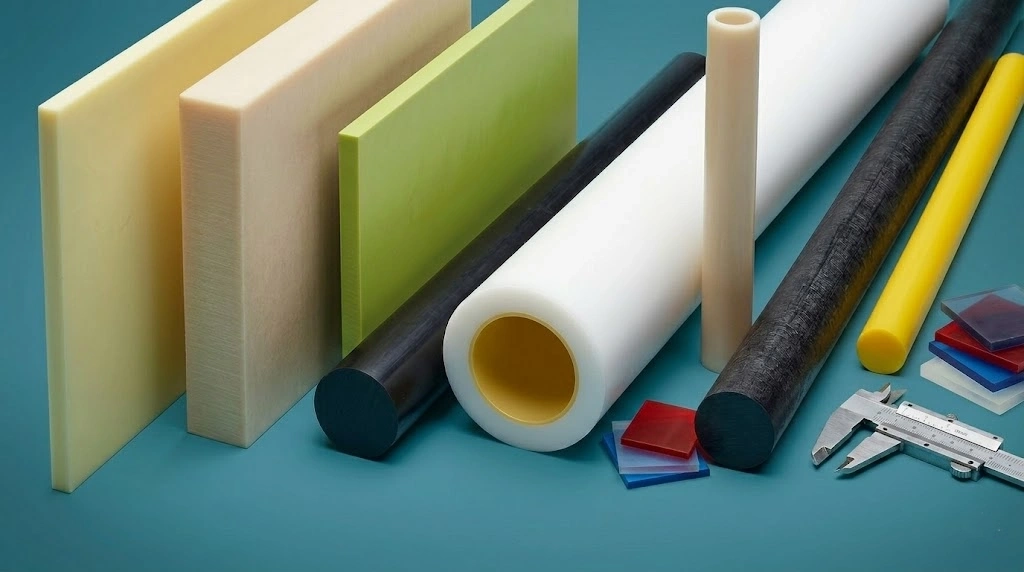
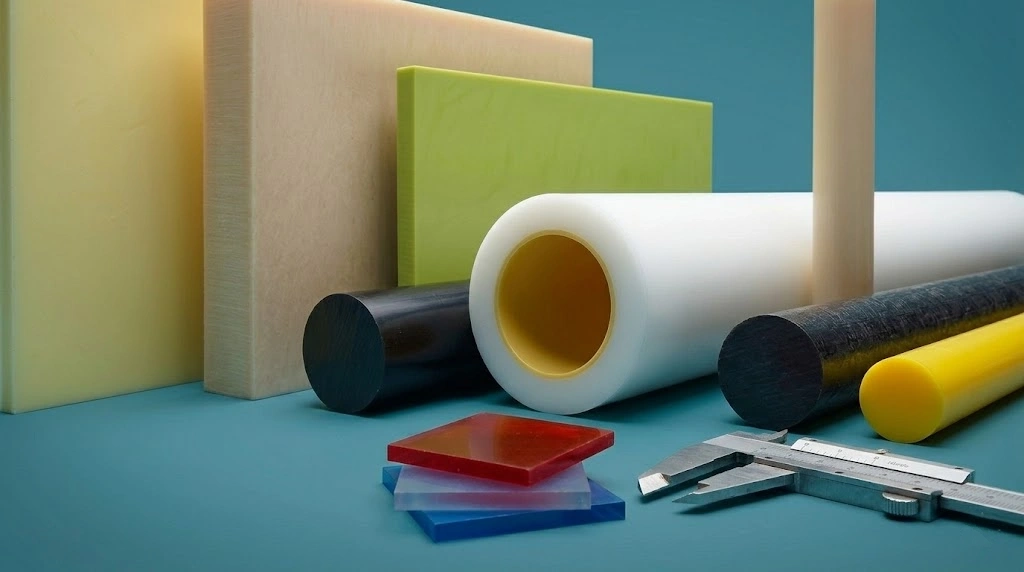
Industrial Experts supplies engineering plastic sheets, rods, and custom-cut parts across all the materials below. Each one has a job that they do well.
Nylon (Polyamide)
Tough, abrasion-resistant, and self-lubricating, this is the standard choice for gears, bushings, sprockets, and rollers. It handles oil and fuels well, though it absorbs moisture, which can affect dimensions in humid environments.
Acetal (POM, Delrin)
High stiffness, low friction, and excellent dimensional stability. Acetal is preferred for precision parts like gears, bearings, and conveyor components. It machines beautifully and holds tolerances better than Nylon.
UHMWPE (Ultra High Molecular Weight Polythylene)
Outstanding wear and impact resistance. UHMWPE is used in chute liners, hopper liners, wear strips, and food contact surfaces. It’s self-lubricating and resists most chemicals.
HDPE
Lower cost workhorse for tanks, cutting boards, marine fittings, and water service. HDPE offers good chemical resistance and is easy to weld or fabricate.
Polycarbonate
This is the toughest transparent plastic available. It’s used for machine guards, sight glasses, and impact-resistant glazing and has roughly 250 times the impact strength of glass.
Polypropylene
Excellent chemical resistance, particularly to acids and bases. Polypropylene is common in chemical tanks, fume hood components, and laboratory fittings.
PVC
Cost-effective, chemically resistant, and easy to fabricate. PVC is standard for non-pressure, ducting, valve bodies, and structure components in chemical environments.
PTFE (Teflon)
The chemical resistance benchmark. Teflon is inert to almost anything and operates from cryogenic temperatures up to 260°C. It’s used for seals, gaskets, valve seats, and bushings in aggressive service.
For full sheet sizes, rod stock, and thicknesses, browse our engineering plastics range. We stock thicknesses from 0.8mm shim stock through to 25mm structural sheet.
When Should You Use Engineering Plastics?
Engineering plastics make sense whenever one of the following is true:
Replacing metal to reduce weight or eliminate corrosion. Acetal bushings outlast bronze in wet service. UHMWPE wear strips replace steel guides in conveyors at a fraction of the weight, with no lubrication required. Nylon gears run quieter than steel and don’t rust.
Parts that run against each other without seizing. Self-lubricating plastics like UHMWPE, Acetal, and Nylon eliminate the need for grease in food, pharmaceutical, and clean room applications where contamination is a problem.
Chemical exposure that would attach metals or commodity plastics. PTFE, polypropylene, and PVC each handle chemical families. Match the material to the media, and you get a part that lasts years rather than weeks.
Precision-machined components in low to medium volumes. Engineering plastics are machined cleanly on standard CNC equipment. For one-off prototypes, short runs, or replacement parts where tooling up an injection mould isn’t economical, machined plastic delivers production-quality parts in days.
Food or potable water contact components. Several engineering plastics, including white Nylon, white UHMWPE, and FDA-grade Acetal, meet food contact requirements while delivering the mechanical performance needed for processing equipment.
When Engineering Plastics Aren’t the Right Choice
They’re not universal. Continuous service above 150°C is not feasible for most engineering plastics, with PTFE and PEEK as the main exceptions. High-pressure structural loads where creep matters are often still metal-dominated. UV exposure degrades many plastics over time, so outdoor applications need either UV-stabilised grades or a different material altogether.
For sealing applications specifically, engineering plastic sheet is just one option. Depending on temperature, pressure, and chemical exposure, rubber, fibre, or composite gaskets may seal better. Our guides on industrial gaskets and sealing solutions cover the alternatives.
How Industrial Experts Can Help
Picking the right engineering plastic comes down to operating temperature, mechanical load, chemical exposure, and budget. Get those four right, and the part will outlast the equipment around it.
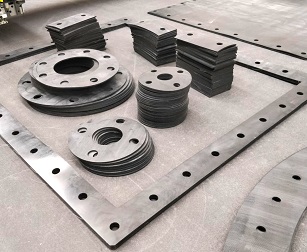
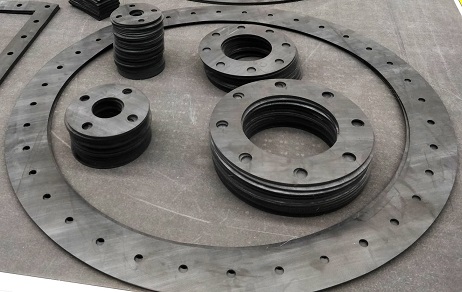
At Industrial Experts, we supply engineering plastics in full sheets, rods, custom-cut shapes, machine parts, and shims. Our in-house CNC oscillating knife cutting and milling capability means we can cut flat profiles, machine 3D parts, and produce custom gaskets from the same plastic stock, all to your DXF file or drawing.
Need help specifying the right material? Send us your application details and our team will recommend the right plastic and supply it cut to size. Get in touch today!




 28 Oct, 2025
 5 Nov, 2025