Applications of Industrial Rubber Strips in Construction & Manufacturing
Home » Applications of Industrial Rubber Strips in Construction & Manufacturing
10 Feb, 2026
Applications of Industrial Rubber Strips in Construction & Manufacturing
When a pharmaceutical manufacturer’s HVAC sealing system failed during a routine audit, the contamination risk could force a complete production shutdown, costing thousands. The culprit? Standard rubber strips that weren’t suited to the temperature cycling and chemical exposure typical in pharmaceutical environments.
This scenario plays out across construction sites and manufacturing facilities daily – where the wrong rubber material choice creates costly failures, safety risks, and compliance headaches.
Industrial rubber strips might seem like straightforward components, but they’re critical to operational integrity across highly regulated industries. From sealing expansion joints in commercial buildings to protecting machine operators from vibration exposure in manufacturing plants, these versatile materials help keep projects running safely and efficiently.
Key Takeaways
Construction applications: Industrial rubber strips seal expansion joints, weatherproof building envelopes, provide waterproofing membranes, dampen vibration in structural components, and create airtight seals around doors and windows
Manufacturing uses: Machine guarding, conveyor belt systems, vibration isolation, equipment sealing, impact absorption, and chemical-resistant barriers
Material selection matters: EPDM excels in weathering applications, neoprene handles moderate chemicals and oils, nitrile resists petroleum-based fluids, silicone meets food-grade requirements, and FKM/Viton withstands extreme chemical exposure
Compliance is critical: Australian projects must meet AS/NZS standards for waterproofing, construction safety, and industry-specific regulations, particularly in food, pharmaceutical, and healthcare applications
Custom solutions deliver better outcomes: Pre-cut strips sized to project specifications reduce waste, installation time, and on-site errors compared to field-cutting standard rolls
What Are Industrial Rubber Strips and Why Do They Matter?
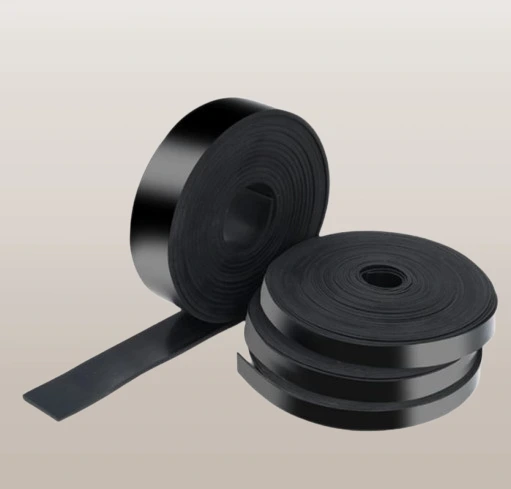
Industrial rubber strips are extruded or calendered elastomer profiles manufactured in continuous lengths, available in various widths, thicknesses, and durometer ratings. Unlike general-purpose rubber products, these strips are engineered for specific performance requirements: temperature tolerance, chemical resistance, compression set properties, and regulatory compliance.
What makes these materials indispensable? Three core properties:
Elasticity and compression recovery: Rubber strips can compress up to 50% of their original thickness and still recover their shape, making them ideal for sealing applications where movement occurs (thermal expansion, structural settling, vibration).
Material versatility: Different elastomers offer dramatically different chemical, temperature, and environmental resistance profiles. EPDM rubber strips excel in outdoor weathering applications, while FKM / Viton rubber strips handle aggressive chemicals and extreme temperatures.
Fabrication flexibility: Strips can be supplied with or without adhesive backing, in solid or sponge formats, and custom-cut to exact dimensions, reducing installation complexity and field waste.
Core Applications in Construction Projects
Construction projects across Australia rely on industrial rubber strips for critical building envelope and structural applications. The construction industry uses rubber products extensively in sealing systems, waterproofing membranes, expansion joints, roofing materials, flooring solutions, and vibration isolation systems.
Expansion Joint Sealing
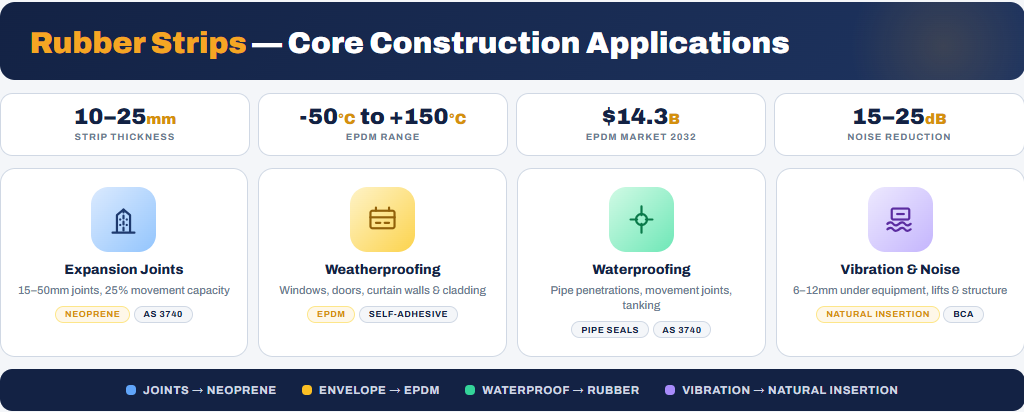
Concrete structures expand and contract with temperature changes. Commercial buildings, car parks, bridges, and industrial facilities require expansion joints that accommodate this movement without cracking or water infiltration. Neoprene rubber strips are frequently specified for expansion joint applications due to their excellent compression set resistance and moderate oil/chemical resistance.
In a typical application, 10-25mm thick neoprene strips are installed in joints ranging from 15-50mm wide, allowing structures to expand up to 25% of the joint width while maintaining a watertight seal. Projects must comply with AS/NZS waterproofing standards, particularly AS 3740 for residential wet areas and AS/NZS 4858 for membrane classification.
Weatherproofing and Building Envelope Sealing
Air leakage through poorly sealed building envelopes accounts for significant energy loss in Australian commercial buildings. Industrial rubber strips create continuous seals around window frames, door assemblies, curtain wall systems, and penetrations.
EPDM rubber strips dominate weatherproofing applications due to their superior UV, ozone, and temperature resistance (-50°C to +150°C). The EPDM rubber market is projected to reach $14.3 billion by 2032, with construction representing a major growth driver as millions of square metres are installed annually in building envelope applications.
Self-adhesive EPDM strips simplify installation on metal window frames, aluminium cladding systems, and prefabricated building components, particularly valuable in modular construction projects where speed and precision matter.
Waterproofing Applications
Waterproofing failures cost building owners millions of dollars annually in remediation costs. While sheet membranes form the primary waterproof barrier, rubber strips play crucial supporting roles:
Pipe penetration sealing: Wrapping penetrations where services pass through concrete slabs or walls
Movement joint sealing: Sealing control joints in tiled wet areas without restricting movement
Tanking transitions: Sealing transitions between different waterproofing products or substrates
Projects requiring waterproofing compliance must reference AS 3740, which specifies performance requirements for materials used in domestic wet areas, along with proper installation procedures.
Vibration Isolation and Noise Control
Multi-storey buildings, particularly those with mixed-use (residential over commercial), require vibration isolation to prevent structure-borne noise transmission. Natural insertion rubber strips, combining natural rubber elasticity with fabric reinforcement, are installed beneath mechanical equipment, lift motors, and structural connections to dampen vibration.
A properly specified vibration-isolation system using 6-12mm rubber strips can reduce structure-borne noise transmission by 15-25dB, which is critical for meeting the Building Code of Australia acoustic requirements.
Essential Manufacturing Applications
Manufacturing facilities face unique challenges: chemical exposure, temperature extremes, continuous machinery operation, and strict safety regulations. The industrial rubber market is heavily driven by the manufacturing sector, where rubber products are essential for automotive manufacturing, electronics, machinery, and food processing applications.
Machine Guards and Safety Barriers
Work Health and Safety regulations require physical barriers to protect operators from moving machinery. Industrial rubber strips form critical components of machine guard assemblies:
Edge protection: Rubber trim strips cover sharp metal edges on guard panels, reducing injury risk during maintenance
Curtain strips: Transparent or opaque rubber strip curtains allow material flow while restricting operator access to hazard zones
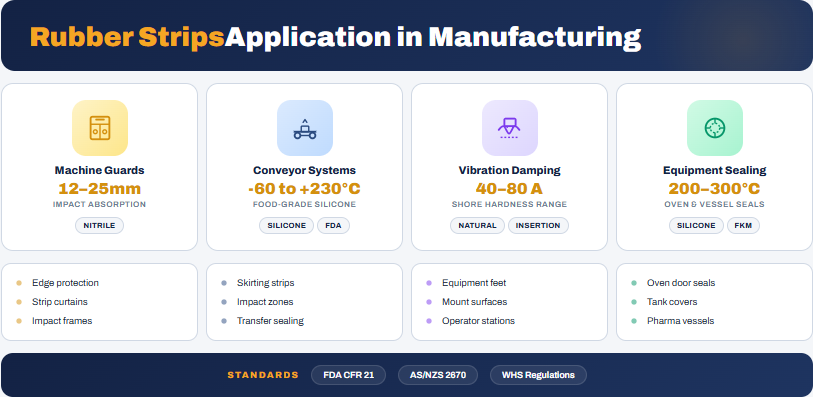
Impact absorption: 12-25mm thick rubber strips on guard frames absorb impacts from moving parts or dropped materials
Nitrile rubber strips are frequently specified for machine guard applications in metalworking facilities due to their excellent abrasion resistance and tolerance to cutting oils and coolants.
Conveyor System Applications
Australian manufacturing and warehousing facilities operate thousands of conveyor systems moving everything from food products to automotive parts. Industrial rubber strips perform several conveyor-related functions:
Skirting strips: Rubber strips along conveyor edges contain materials and prevent spillage
Impact zones: Cushioning strips beneath loading points absorb impact and extend belt life
Transfer point sealing: Strips seal gaps between conveyor sections, preventing material escape and dust generation
Food processing conveyors require silicone rubber strips that meet the FDA CFR 21 177.2600 standards for direct food contact. Silicone maintains flexibility and stability from -60°C (blast freezers) to +230°C (cooking lines) while resisting bacterial growth.
Vibration Damping and Isolation
Manufacturing machinery generates significant vibration, which accelerates wear, reduces precision, and causes operator discomfort.
Rubber strips are installed:
Beneath equipment feet: Isolating machinery from concrete floors (particularly critical for CNC equipment requiring micron-level precision)
Between mounting surfaces: Dampening transmission between components in assembly lines
Around operator stations: Reducing whole-body vibration exposure to meet AS/NZS 2670 vibration exposure limits
Engineers specify rubber strips based on durometer (Shore A rating) and dynamic properties – softer durometers (40-60 Shore A) provide better vibration isolation, while harder materials (70-80 Shore A) offer better load-bearing capacity.
Equipment Sealing and Gasketing
Manufacturing equipment operates in challenging environments: wash-down areas, chemical processing zones, and high-temperature ovens. Industrial rubber strips create seals that protect internal components while allowing necessary equipment access:
Oven door seals: High-temperature silicone strips maintain thermal efficiency while withstanding 200-300°C operating temperatures
Tank and vessel access covers: Chemical-resistant strips seal inspection hatches and maintenance ports
Pharmaceutical processing equipment: FDA-compliant strips seal mixing vessels, tablet presses, and coating drums
For chemical processing applications, material selection is critical. Our rubber gasket materials comparison guide helps engineers match elastomer properties to specific chemical exposures.
Material Selection Guide: Matching Rubber to Application
Selecting the wrong rubber material is the leading cause of premature seal failure. Each elastomer offers distinct advantages and limitations.
Material
EPDM (Ethylene Propylene Diene Monomer)
Neoprene (Polychloroprene)
Nitrile (NBR – Nitrile Butadiene Rubber)
Silicone
FKM/Viton (Fluorocarbon)
Best For
Outdoor weathering, water exposure, steam, weak acids and alkalis
Moderate chemical resistance, outdoor applications, refrigeration
Oil and fuel resistance, petroleum-based fluids, hydraulic systems
For comprehensive elastomer properties and selection criteria, reference our detailed rubber gasket materials guide.
Performance Properties That Drive Selection Decisions
Beyond material type, specific performance properties determine whether a rubber strip will succeed in its application:
Hardness (Durometer)
Measured on the Shore A scale (for most rubber strips), durometer indicates resistance to indentation. Typical ranges:
40-50 Shore A: Soft, highly compressible – ideal for vibration isolation and irregular surface sealing
60-70 Shore A: Medium hardness – balanced compression and durability for general sealing
75-85 Shore A: Harder materials – better load-bearing and abrasion resistance for wear applications
Compression Set
Compression set measures rubber’s ability to recover its original thickness after prolonged compression. Lower compression set percentages indicate better recovery (20% compression set means the material recovers 80% of its original thickness).
Critical for applications where seals remain compressed for extended periods (door seals, expansion joints, equipment gaskets). EPDM typically shows 20-30% compression set, while nitrile ranges from 15-35% depending on formulation.
Temperature Resistance
Each elastomer has distinct temperature performance:
Upper limit: Temperature at which material begins degrading (hardening, cracking, losing elasticity)
Lower limit: Temperature at which material becomes too stiff to compress effectively
Applications involving temperature cycling (outdoor equipment, oven doors, refrigeration) require materials maintain properties across the full temperature range.
Chemical Compatibility
Material degradation from chemical exposure manifests as:
Swelling: Absorption of chemicals causing dimensional changes
Softening: Loss of structural integrity and durometer
Hardening: Embrittlement and loss of flexibility
Cracking: Surface deterioration progressing to failure
Installation and Specification Considerations
Adhesive vs Non-Adhesive Backing
Self-adhesive rubber strips offer faster installation, consistent bond and coverage, and a cleaner process by eliminating mess and curing time of liquid adhesives.
However, adhesive backing adds cost and requires properly prepared surfaces (clean, dry, degreased). Non-adhesive strips are suitable for applications where mechanical fastening is preferred or where the strip is held by compression.
Solid vs Sponge Rubber
Solid rubber strips: Dense, non-porous structure providing maximum durability, tear resistance, and barrier properties. Used where sealing integrity, chemical resistance, and longevity matter most.
Sponge rubber strips: Cellular structure (closed-cell or open-cell) offering higher compressibility and better cushioning. Open-cell sponge absorbs liquids; closed-cell resists moisture penetration. Ideal for vibration isolation, gap filling on irregular surfaces, and cushioning applications.
Custom Cutting Benefits
Pre-cut custom rubber strips to project specifications deliver measurable advantages:
Reduced waste: Minimise off-cuts and excess material purchasing
Faster installation: Eliminate on-site measuring and cutting
Labour savings: Reduce skilled labour time on site
Better edge quality: Clean factory cuts vs rough field-cut edges
For projects requiring multiple strip sizes or complex profiles, custom cutting from Australian suppliers like Industrial Experts eliminates lead time delays associated with international sourcing.
Why Material Selection Expertise Matters
The difference between an industrial rubber strip that performs for years and one that fails within months comes down to proper material selection, quality manufacturing, and expert specification support.
Industrial Experts supplies the complete range of industrial rubber strips engineered for Australian construction and manufacturing applications. With expertise in FDA-compliant materials, custom cutting services, and comprehensive technical support, we help engineers and project managers select the right solution the first time – eliminating costly failures and project delays.



 28 Oct, 2025
 5 Nov, 2025